AkkuFresh
Test by IBM Magyarország Kft. on Lenovo notebook battery
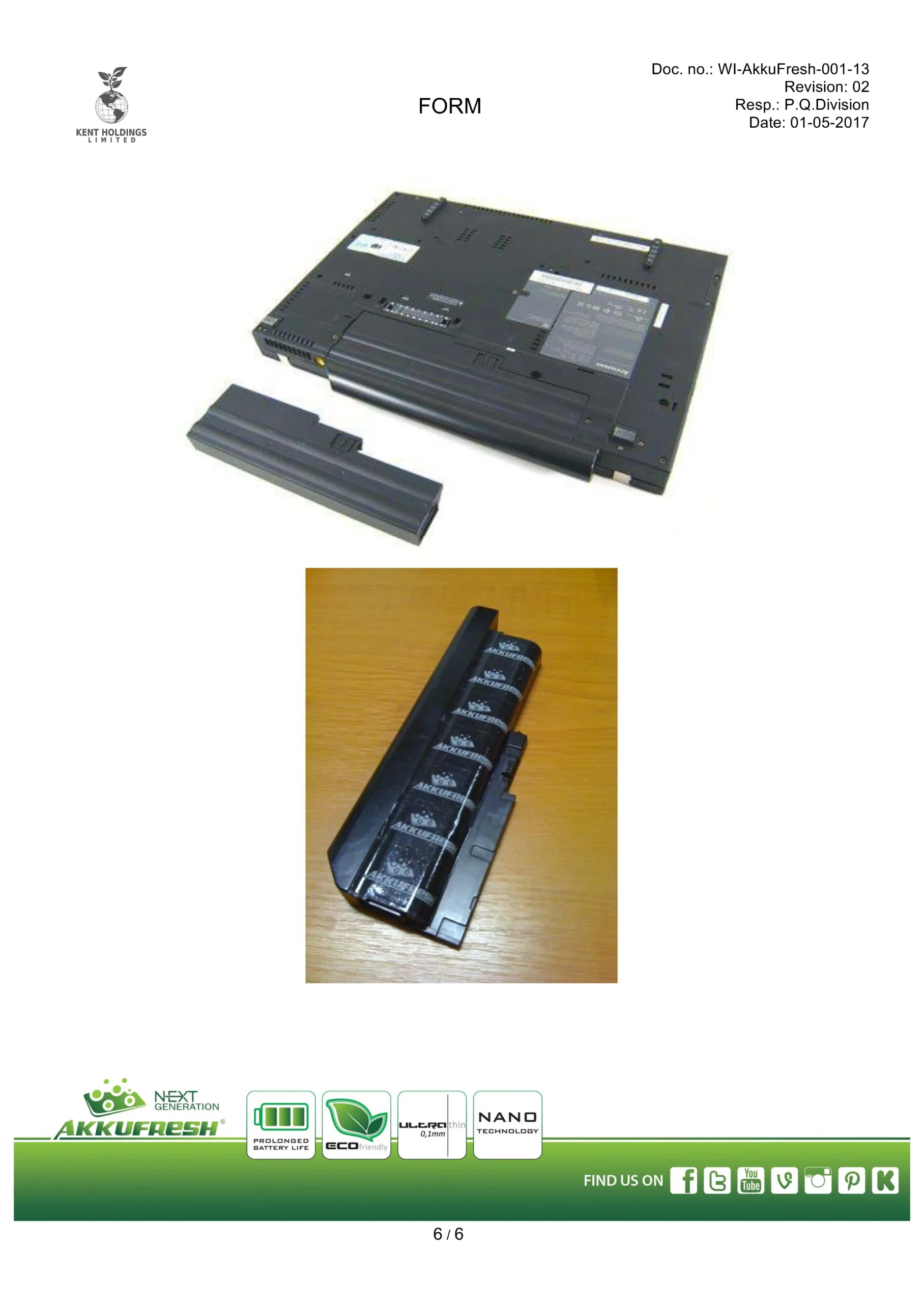
We received great news in 2010.04. IBM has tested one of our company’s notebook’s battery on 2010.04. Of course, we have applied our AkkuFresh® Next Generation™ battery life foil on an IBM Lenovo notebook battery since the beginning of the use of this notebook, which is more than 3 years old. The test shows that the battery is in the same condition as it was 3 years ago! It means that AkkuFresh® holds the battery’s condition at the original capacity. IBM says that they have never seen this before!
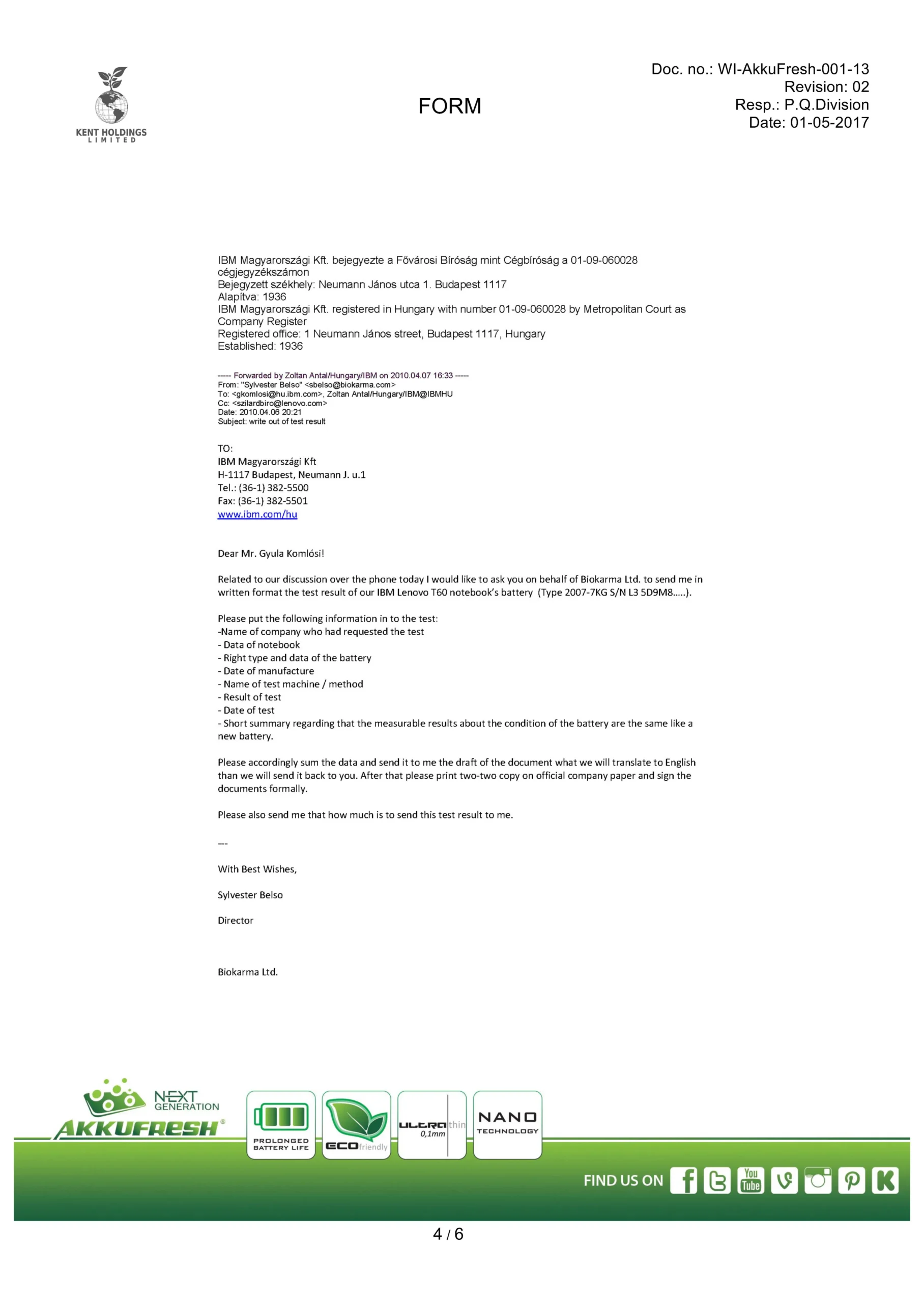
The person from IBM Hungary who did the test on the battery did say that there is no problem with sending us the result. Before he had sent this test result to us, he had talked with the service manager, who had called us and informed me that IBM service can’t provide the printed test result without him talking with the IBM communication department and Lenovo Hungary.
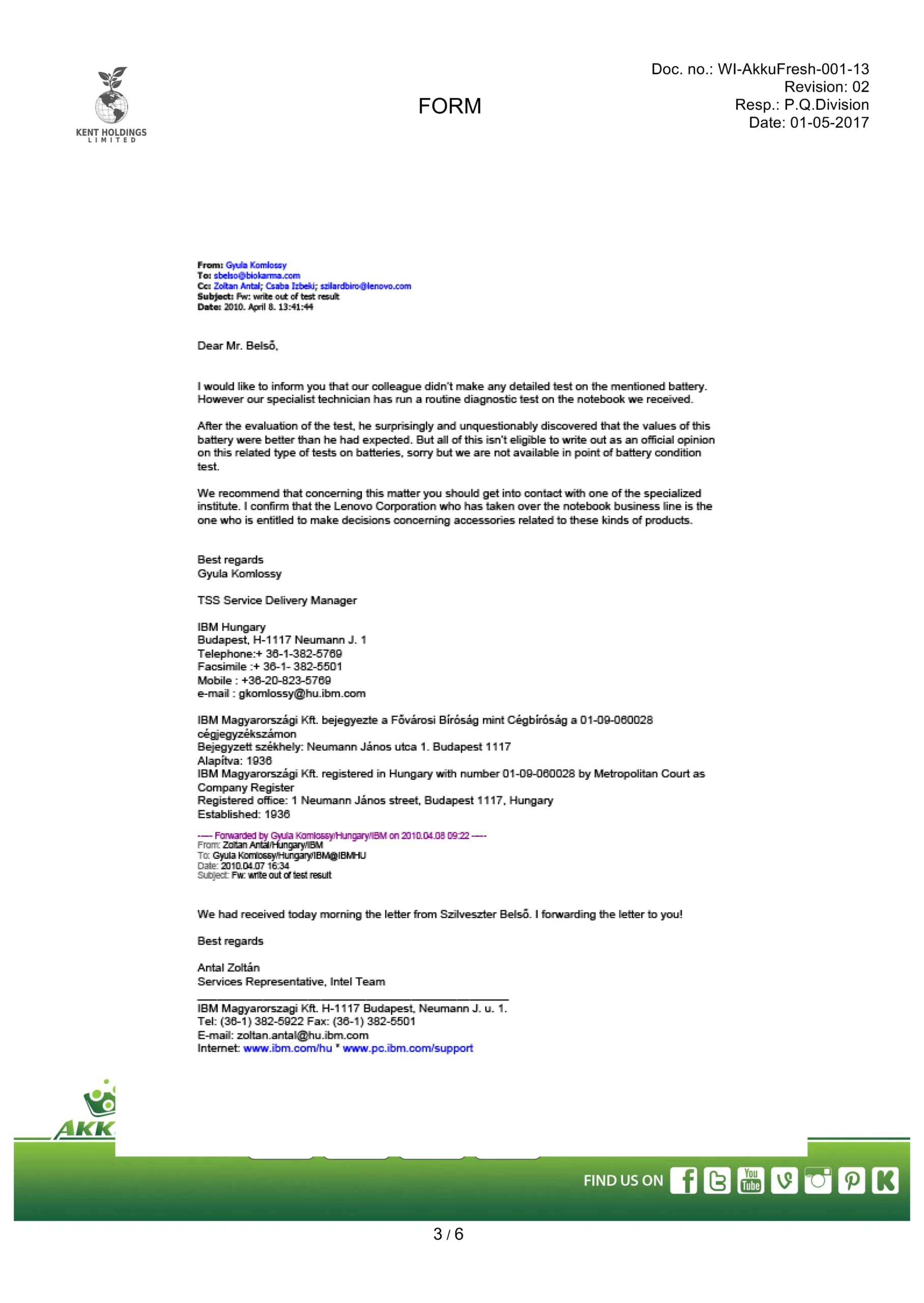
We talked with Lenovo Hungary, where the person informed us that they can’t assist with this because they can’t control or instruct IBM service on what to do. He said that this is the way with big corporations. Finally, I put the two people (IBM & Lenovo) on the 3-way call and asked the IBM Hungary service manager to send me the document. After a day, I had received the following e-mail: As you can see, the letter from IBM/Lenovo Hungary’s Service Manager quoted the original information shared with our company on the phone very carefully: “…or specialist technician has run the routine diagnostic test on the notebook we received. After the evaluation of the test, he surprisingly and unquestionably discovered that the values of this battery were better than he had expected.”
We were disappointed because we had requested more detailed test results. The technician who had carried out the test had told us on the phone that he’s company, IBM Hungary, was afraid that the American headquarters would do something after they issued the type of detailed test results. Don’t forget that we are talking about one of the biggest computer manufacturers in the world.
IBM does not currently have battery research programs in place. However, Narayan says that IBM has the expertise needed to tackle the science problems. In addition to Oak Ridge, IBM will partner with Lawrence Berkeley, Lawrence Livermore, Argonne, and Pacific Northwest national labs. The company and its collaborators are currently working on a proposal for funding from the U.S. Department of Energy under the Advanced Research Projects Agency-Energy.
Research on lithium-metal batteries stalled about 20 years ago. In 1989, Canadian company Moli Energy recalled its rechargeable lithium-metal batteries, which used not air but a more traditional cathode, after one caught fire; the incident led to legal action, and the company declared bankruptcy. Soon after, Sony brought to market the first rechargeable lithium-ion batteries, which were safer, and research on lithium-metal electrodes slowed nearly to a halt. (After restructuring, Moli Energy refocused its research efforts and is now selling lithium-ion batteries under the name Molicel.) Only a handful of labs around the world, including those at PolyPlus Battery, in Berkeley, CA, Japan’s AIST, and St. Andrews University, in Scotland, are currently working on lithium-air batteries.
The effect and performance of AkkuFresh® Next Generation™ depends on several factors: Type of device (mobile phone / notebook / camera / etc,), brand, model – type of battery, age, status (total amount of charging-discharging cycles), external temperature, environmental conditions and cellular network.
Certificate images